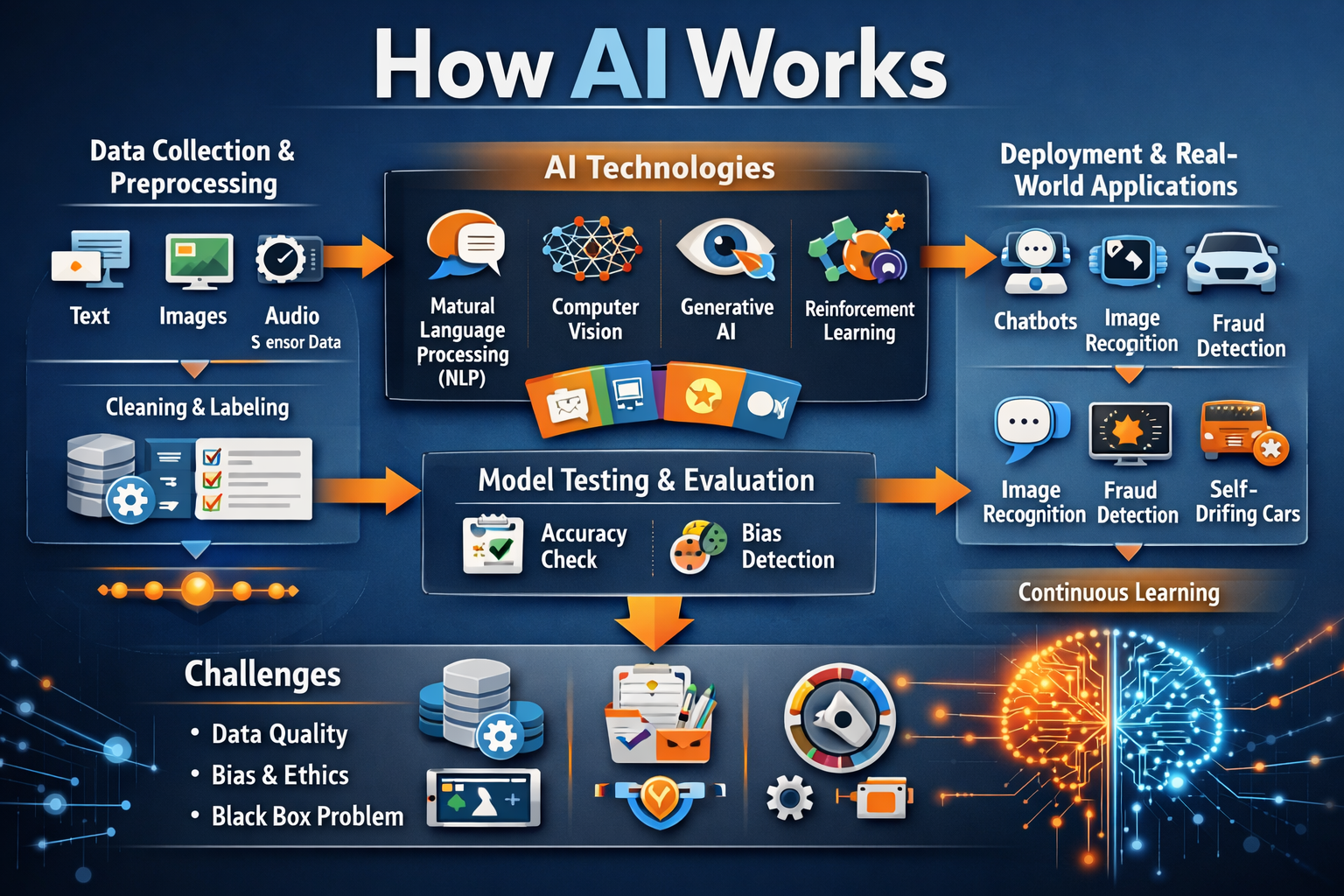
Artificial Intelligence (AI) is no longer science fiction — it’s a part of our everyday lives, from chatbots and voice assistants to recommendation engines and autonomous vehicles. But how exactly does AI work? In this article, we break down the step-by-step process, core technologies, applications, challenges, and future trends to give you a complete understanding of AI.
Table of Contents
- 01: Introduction — Understanding AI
- 02: A Brief History of AI
- 03: How Does AI Work? The Core Process
- 3.1 Step 1: Data Collection
- 3.2 Step 2: Data Preprocessing
- 3.3 Step 3: Choosing the Right AI Model
- 3.4 Step 4: Training the AI Model
- 3.5 Step 5: Testing and Validation
- 3.6 Step 6: Deployment
- 04: Core AI Technologies Explained
- 4.1 Machine Learning (ML)
- 4.2 Neural Networks
- 4.3 Natural Language Processing (NLP)
- 4.4 Computer Vision
- 4.5 Generative AI
- 05: AI Learning Methods in Detail
- 06: Applications of AI
- 07: Challenges and Limitations of AI
- 08: The Future of AI
- 09: FAQs About AI
- 10: Conclusion
- 11: SEO-Friendly Image Prompt
Introduction — Understanding AI
Artificial Intelligence (AI) is transforming the way we live, work, and interact with technology. At its simplest, AI is the simulation of human intelligence in machines, enabling them to perform tasks that typically require human thought, such as understanding language, recognizing patterns, making decisions, or even creating content.
Modern AI powers everything from voice assistants like Siri and Alexa, to recommendation engines on Netflix, fraud detection systems in banking, and autonomous vehicles. But how does AI actually work?
In this article, we’ll break it down step by step — from data collection to advanced machine learning techniques, real-world applications, and the future of AI.
A Brief History of AI
AI isn’t new — it has been developing for decades:
- 1950s: Alan Turing asked, “Can machines think?” and introduced the Turing Test.
- 1956: John McCarthy coined the term Artificial Intelligence.
- 1960s–1980s: Early AI focused on rule-based systems and simple logic.
- 1990s: AI evolved with machine learning algorithms and data-driven approaches.
- 2010s–2020s: Deep learning and neural networks revolutionized AI, enabling applications like self-driving cars, language models, and image recognition.
Understanding AI’s history helps us see how it has evolved from simple rule-based programs to the advanced, adaptive systems we rely on today.
How Does AI Work? The Core Process
AI works by analyzing data, learning patterns, and making predictions or decisions. Here’s the step-by-step process:
Step 1: Data Collection
Data is the lifeblood of AI. AI systems rely on large amounts of structured and unstructured data:
- Structured data: Spreadsheets, databases
- Unstructured data: Images, videos, audio, text
The more relevant and high-quality data an AI system has, the better it can learn. For example, a self-driving car needs thousands of hours of video footage to recognize road signs and pedestrians.
Step 2: Data Preprocessing
Raw data often contains errors, duplicates, or irrelevant information. Preprocessing ensures AI learns effectively:
- Cleaning: Removing inconsistencies or missing values
- Normalization: Scaling data for consistency
- Labeling: Tagging data for supervised learning (e.g., labeling images as “dog” or “cat”)
Proper preprocessing improves AI accuracy and reduces errors in predictions.
Step 3: Choosing the Right AI Model
AI relies on different models depending on the task:
- Supervised Learning: Trains on labeled data to predict outcomes. Example: Spam email detection.
- Unsupervised Learning: Finds hidden patterns in unlabeled data. Example: Customer segmentation.
- Reinforcement Learning: Learns through trial and error with rewards. Example: AlphaGo, autonomous robots.
Deep learning models use multiple layers of artificial neural networks to process complex inputs like images, language, or audio.
Step 4: Training the AI Model
Training is where the AI actually “learns.”
- The model makes predictions based on the training data
- Compares predictions to actual outcomes
- Adjusts internal parameters to minimize errors
This iterative process continues until the AI achieves a high level of accuracy. The more data and training time, the better the model performs.
Step 5: Testing and Validation
Before deployment, AI models are tested on new, unseen data:
- Accuracy: How often does the AI make correct predictions?
- Bias detection: Are certain outcomes unfairly favored?
- Performance evaluation: How quickly and efficiently does the model operate?
Testing ensures AI works reliably in real-world situations.
Step 6: Deployment
Once validated, AI models are deployed in applications:
- Chatbots answering customer queries
- AI-powered recommendation engines on e-commerce sites
- Self-driving car navigation systems
- AI-based diagnostic tools in healthcare
After deployment, AI systems often continue learning from new data to improve performance over time.
Core AI Technologies Explained
Understanding AI requires familiarity with its key technologies:
Machine Learning (ML)
Machine learning allows AI to learn from data instead of following explicit rules. Popular ML techniques include:
- Linear regression: Predicts numerical outcomes (e.g., house prices)
- Decision trees: Classifies data by branching rules
- Random forests: Multiple decision trees combined for accuracy
Neural Networks
Neural networks mimic the human brain with interconnected nodes (neurons).
- Input layer: Receives raw data
- Hidden layers: Process data and detect patterns
- Output layer: Produces predictions or classifications
Deep learning uses multiple hidden layers to handle complex tasks like image recognition and natural language processing.
Natural Language Processing (NLP)
NLP allows AI to understand, interpret, and generate human language. Applications include:
- ChatGPT and AI chatbots
- Language translation (Google Translate)
- Sentiment analysis for social media
NLP models analyze context, syntax, and semantics to produce human-like text.
Computer Vision
Computer vision enables AI to interpret visual information:
- Detecting objects in photos
- Recognizing faces
- Diagnosing medical images
It combines image processing, machine learning, and deep learning techniques.
Generative AI
Generative AI doesn’t just predict — it creates new content:
- Text generation (articles, chatbots)
- Image creation (DALL-E, MidJourney)
- Audio and video synthesis
It works by learning patterns in existing data and producing outputs that mimic real-world examples.
AI Learning Methods in Detail
AI uses different learning strategies depending on the data and objectives:
- Supervised Learning: Works with labeled data
- Unsupervised Learning: Finds patterns in unlabeled data
- Reinforcement Learning: Learns by trial and error
- Semi-supervised Learning: Combines small labeled data with large unlabeled datasets
Applications of AI
AI is applied across industries:
- Healthcare: Predictive diagnostics, medical imaging, personalized treatment
- Finance: Fraud detection, automated trading, credit scoring
- Retail: Product recommendations, inventory management, customer behavior analysis
- Transportation: Autonomous vehicles, traffic prediction, route optimization
- Marketing: Chatbots, AI content creation, targeted advertising
Challenges and Limitations of AI
Despite its potential, AI has challenges:
- Data dependency: Requires large, high-quality datasets
- Bias: Can reflect biases present in training data
- Transparency: Complex AI models can be “black boxes”
- Cost: Training AI models can be expensive
- Ethical concerns: Job displacement, privacy issues, misuse
The Future of AI
AI is evolving rapidly:
- Explainable AI: Making models transparent and understandable
- Artificial General Intelligence (AGI): Machines with human-level reasoning
- AI in everyday life: Smarter homes, cities, healthcare systems
- AI ethics and regulation: Ensuring safe and fair AI use
FAQs About AI
Q1: Can AI replace humans?
A: AI enhances human capabilities but cannot fully replace human creativity and judgment — yet.
Q2: What is the difference between AI and machine learning?
A: AI is the broader concept of machines simulating intelligence, while ML is a subset that learns from data.
Q3: How much data does AI need?
A: It depends on the task — simple models may need thousands of examples, complex deep learning models may require millions.
Q4: Is AI dangerous?
A: AI can be misused, but responsible development and regulation can minimize risks.
Conclusion
AI works by processing data, learning patterns, and making predictions or decisions. From machine learning and neural networks to NLP, computer vision, and generative AI, these systems are revolutionizing every industry.
Businesses and founders who understand how AI works can harness its power to automate tasks, improve decision-making, and unlock unprecedented growth. INVOLYX