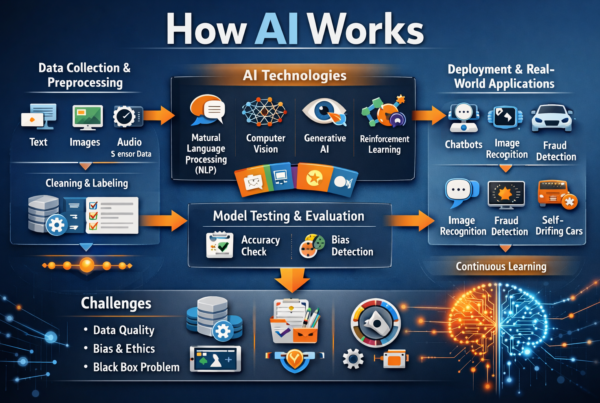
Artificial Intelligence (AI) has evolved from a futuristic concept to a business-critical technology. By 2026, AI will be an essential driver of operational efficiency, innovation, and strategic decision-making. Businesses that successfully integrate AI can automate repetitive tasks, enhance customer experiences, forecast trends, improve decision-making, and uncover new revenue streams.
At Involyx, we help organizations implement AI thoughtfully and effectively, ensuring that technology delivers measurable value. This comprehensive guide provides a step-by-step roadmap to implement AI in your business in 2026, covering planning, data strategy, workflows, technologies, scaling, and continuous innovation.
Step 1: Define Clear Business Objectives for AI
AI implementation begins with clarity on what you want AI to achieve. Without clear goals, AI initiatives risk being costly experiments with limited impact.
Actionable Steps:
- Collaborate Across Teams: Engage leaders from operations, marketing, finance, and customer support to identify pain points and opportunities for AI.
- Prioritize Use Cases: Evaluate potential AI applications based on ROI, complexity, and alignment with business strategy. Balance quick wins with long-term transformational projects.
- Set KPIs: Define measurable indicators such as cost reduction, revenue growth, process efficiency, error reduction, and customer satisfaction improvements. Include both quantitative and qualitative metrics.
- Develop a Roadmap: Draft timelines, budget estimates, and resource allocation for the AI lifecycle, including data preparation, model development, pilot projects, deployment, and ongoing monitoring.
Why it matters: Well-defined objectives ensure AI projects address real business needs, avoid wasted resources, and generate tangible results.
Case Example: A logistics company identified shipment delays as a major pain point. Using AI for predictive route optimization reduced delivery time by 20% and lowered fuel costs by 15%.
Step 2: Assess Data Readiness and Infrastructure
AI depends on high-quality data and robust infrastructure. Before starting, evaluate your data and IT capabilities.
Key Actions:
- Data Audit: Map all data sources—internal databases, CRM systems, IoT devices, sensors, and external datasets. Assess accuracy, completeness, and timeliness.
- Data Cleaning: Remove duplicates, normalize formats, validate accuracy, and establish governance policies for data ownership, access, and security.
- Infrastructure Assessment: Ensure sufficient cloud computing resources, storage, and processing power (GPUs/TPUs). Consider hybrid or multi-cloud approaches for scalability and cost efficiency.
- Tool Selection: Evaluate AI platforms, pre-built models, and frameworks. Microsoft Azure AI, Google AI Platform, AWS SageMaker, and open-source tools like TensorFlow or PyTorch offer various levels of integration and customization.
Why it matters: Reliable data and infrastructure are critical for training accurate AI models and deploying solutions at scale.
Example: A retail company consolidated customer purchase data from online and offline channels into a central data lake. This enabled an AI-powered recommendation engine, increasing average order value by 18%.
Step 3: Build Cross-Functional AI Expertise
Successful AI adoption requires both technical and business expertise.
Actions:
- Internal Talent: Identify data scientists, ML engineers, software developers, and analysts. Offer upskilling programs to bridge knowledge gaps.
- Clear Roles: Assign AI project managers to coordinate between technical and business teams.
- External Expertise: Partner with AI vendors, consultants, or academic institutions to access specialized knowledge.
- Collaborative Culture: Encourage experimentation, knowledge sharing, and iterative model development.
Why it matters: A well-rounded team ensures AI solutions are technically sound and aligned with business challenges.
Example: A fintech startup combined internal data engineers with external AI consultants to implement a fraud detection system, reducing fraudulent transactions by 40% in the first year.
Step 4: Develop and Pilot AI Solutions
Pilot projects allow businesses to validate AI use cases before full-scale deployment.
Actions:
- Start small with manageable but high-impact pilots.
- Apply agile development for iterative improvements based on feedback.
- Document datasets, models, and results for transparency and compliance.
- Measure performance against predefined KPIs.
Why it matters: Pilots reduce risk, demonstrate value, and build organizational confidence.
Example: A manufacturing firm piloted AI-powered predictive maintenance on a single production line. The pilot reduced unplanned downtime by 25%, leading to a company-wide rollout.
Step 5: Deploy AI Solutions and Monitor Continuously
AI deployment is not the end—it requires ongoing oversight.
Actions:
- Automate Monitoring: Track model performance, accuracy, bias, and latency in production.
- Model Retraining: Update models regularly with new data to maintain relevance.
- Workflow Integration: Ensure AI outputs are seamlessly used in decision-making and operational processes.
- User Feedback: Collect feedback to improve usability and address emerging business needs.
Why it matters: Continuous monitoring ensures sustained performance, ethical compliance, and long-term ROI.
Example: An e-commerce platform continuously monitors AI-driven product recommendations. Iterative improvements increased click-through rates by 22% and conversions by 15%.
Step 6: Scale AI Across the Organization
After successful pilots, scale AI to maximize impact:
- Train employees and ensure IT support readiness.
- Integrate AI with enterprise systems such as ERP, CRM, and supply chain platforms.
- Implement AI governance policies for ethical standards, model approval, and data management.
- Track impact organization-wide to maintain executive support and demonstrate value.
Why it matters: Scaling embeds AI into core business processes, driving transformation across the enterprise.
Example: A healthcare provider scaled AI diagnostics from a single clinic to multiple hospitals, improving diagnosis accuracy by 30% and reducing patient wait times.
Step 7: Foster Innovation and Continuous Improvement
AI adoption is an evolving journey.
Actions:
- Experiment with emerging AI technologies such as generative AI, reinforcement learning, and edge AI.
- Stay updated on AI research, trends, and regulations.
- Encourage collaboration between business, IT, and AI teams.
- Partner with startups, academia, and vendors to accelerate innovation.
Why it matters: Continuous innovation ensures AI initiatives remain relevant and competitive.
Example: A marketing agency experimented with generative AI to create ad copy and visuals. The new AI-powered campaigns increased engagement by 35% while reducing creative production time by 50%.
Step 8: Best Practices for Ethical and Responsible AI
- Ensure transparency by documenting models and decisions.
- Monitor for bias and take corrective action.
- Comply with regulatory frameworks like GDPR and CCPA.
- Promote a culture of AI literacy and ethical use among employees.
Why it matters: Responsible AI builds trust, avoids reputational risks, and ensures long-term sustainability.
Conclusion
Implementing AI in your business in 2026 requires strategic planning, skilled execution, and ongoing monitoring. By following this comprehensive step-by-step guide, businesses can unlock operational efficiency, innovation, and competitive advantage.
At Involyx, we specialize in helping organizations integrate AI into their operations, delivering tailored solutions that are scalable, ethical, and future-ready.
Call-to-Action:
Start your AI journey today. Contact Involyx to learn how AI can transform your business operations, customer experiences, and growth strategies in 2026.